Friday, October 9, 2009

US20 In Ohio: Dangerous Intersections

US20/SR 306 Intersection (Google Street View)

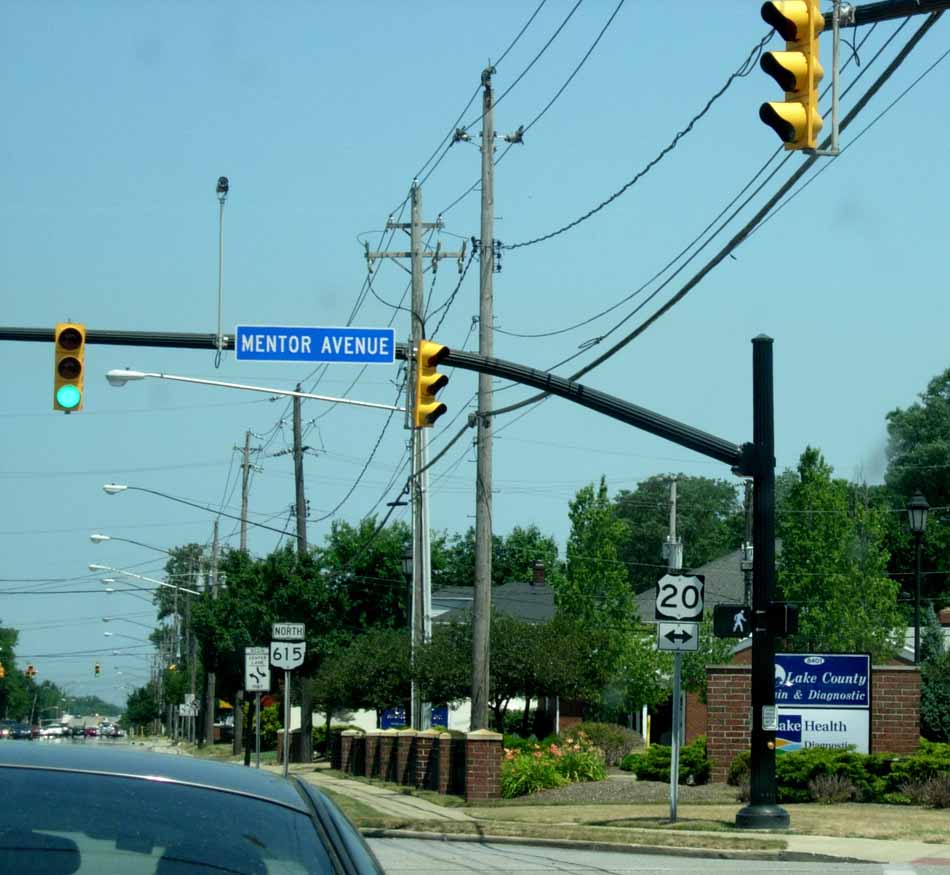
When driving US Route 20, one can see some beautiful sights. But there is also a dangerous side to the nation’s longest road. A news story published today by the Cleveland Plain Dealer indicates that the intersection of US Route 20 (Mentor Avenue) and State Route 306 (Reynolds Road) in Mentor, Ohio (Lake County) is the second most dangerous intersection in the Greater Cleveland area. The rankings were compiled using the top crash locations between 2005-2007, in a report published by the Northeast Ohio Areawide Coordinating Agency in 2009. As Route 306 connects 2 freeways, I-90 and State Route 2, separating them by only a few miles, significant car and heavy truck traffic travels through the US 20 intersection, which lies midway between both freeways. The city of Mentor has already made improvements to the intersection based on the findings from this report, which wasn’t released until mid-2009.


In addition, US20 is also listed two other times on the list for dangerous intersections in the same county: US 20 and State Route 84 (Mentor) and US Route 20 and State Route 91 in Willoughby.


The chart showing the rankings can be found at this link for the Cleveland Plain Dealer.


The US Route 20 Blog homepage can be found at usroutetwenty.blogspot.com, here.

Thursday, September 10, 2009

US20 In Ohio: Cleveland’s Public Square

Public Square (Google Maps)

US Route 20 has a very prominent place in the city of Cleveland, Ohio. It is one of the key roads to and through Public Square, which is the center of the city of Cleveland and has its roots all the way back to the "Original Plan of the Town and Village of Cleaveland" (yes, it was originally spelled “Cleaveland”), prepared in 1796 by the Connecticut Land Company. While passing the Square on the south and east side, it is known as Euclid Avenue. On the north and west side of the Square, it runs concurrently with US Route 6 (AKA the Grand Army of the Republic Highway) and US Route 42, and is called Superior Avenue, and then later Detroit Avenue after it crosses the Cuyahoga River.


US 20 Euclid Ave. westbound into Public Square, the Terminal Tower and the Soldiers and Sailors Monument in view

Public Square, Old Stone Church in background (note the shadow of the Terminal Tower on the buildings to the left of the church) © chrisazimmer, used with permission


As it skirts Public Square, US 20 passes many landmarks, both old and new; The Old Stone Church, The Soldiers and Sailors Monument , and 200 Public Square are some examples. The Terminal Tower is on the Square itself, and US 20 passes only a few hundred feet from the entrance of Cleveland’s most famous landmark.

Old Postcard (undated) of Public Square with US 20 notations added


US 20 and base of 200 Public Square (Tower) (Google Earth)


All Original Text Content © usroutetwenty.blogspot.com unless otherwise noted

The US Route 20 Blog homepage can be found at usroutetwenty.blogspot.com, here.

Saturday, August 29, 2009

US20 in Ohio: Police Chase

And now for something completely different…Here is a video of a police chase (dashcam video) that took place in part on US Route 20 (Mentor Avenue/Euclid Avenue) in Willoughby Ohio.

The police chase began when police, driving on US20 Mentor Avenue eastbound over the Chagrin River bridge, saw the driver traveling at 65 mpg in a 35 mph zone. The police car turned around and headed westbound, towards the intersection where US20 changes from Mentor Avenue to Euclid Avenue. The police car turns left and begins to travel through downtown Willoughby (Euclid Ave.), veers off a few side streets temporality, and eventually turns right and gets back on US 20. The car stays on US20 for quite some time, until the police car makes a hard right on to US 91.

Enjoy the ride!

(If you can’t view the video here, it can also be located on the WKYC website at this link.)


The US Route 20 Blog homepage can be found usroutetwenty.blogspot.com, here.

Thursday, August 20, 2009

US20 In Iowa: Waterloo


US Route 20 passes through the southern side of Waterloo, Iowa. South and east of the city it connects with Interstate 380 and Iowa Highway 27, then crosses US Route 63 as US 20 continues to head west.

Wikipedia gives this information about the early days of Waterloo, Iowa and the naming of the city:


Waterloo was originally known as "Prairie Rapids Crossing". The town was established near two Meskwaki Native American villages alongside the Cedar River. It was first settled in 1845 when George and Mary Hanna and their children arrived on the east bank of the Red Cedar River (now just called the Cedar River). They were followed by the Virden and Mullan families in 1846. Evidence of these earliest families can still be found in the street names Hanna Blvd., Mullan Avenue and Virden Creek.

The name "Waterloo" supplanted the original name, "Prairie Rapids Crossing" shortly after Charles Mullan petitioned for a post office in the town. Since the signed petition did not include the name of the proposed post office location, Mullan was charged with selecting the name when he submitted the petition. Tradition has it that as he flipped through a list of other post offices in the United States, he came upon the name "Waterloo." The name struck his fancy, and on December 29, 1851, a post office was established under that name. The town was later called the same, and Mullan served as the first postmaster from December 29, 1851 until August 11, 1854.


Waterloo is also the county seat of Black Hawk County. It also is home to the Grout Museum District, which is a group of museums that include the Grout Museum of History & Science, the Bluedorn Science Imaginarium, the Snowden House, the Rensselaer Russell House Museum and the Sullivan Brothers Iowa Veterans Museum.


All Original Text Content © usroutetwenty.blogspot.com unless otherwise noted

The US Route 20 Blog homepage can be found usroutetwenty.blogspot.com, here.

Thursday, July 30, 2009

US20 In Ohio: Lawnfield, Revisited

My first full blog post here was covering Lawnfield, the home of the 20th President of the United State, James A. Garfield, which is located on US Route 20 in Mentor, Ohio.

Not only am I fortunate enough to live less than a half mile from US 20, I live less than two miles from Lawnfield, a National Historic Site. Since it was a beautiful summer day, I thought I’d take a quick drive to Lawnfield and get some updated pictures of the house and the grounds (I got there too early today and the house interior wasn’t open.) I saw something on the grounds that I did not see the last time I was there – it was an artist’s depiction of Garfield’s property and the area around it during the time of Garfield’s 1880 presidential campaign. It clearly shows US Route 20, which was - and still is - known as Mentor Avenue. (I’ve highlighted in with a large arrow on the photo below so it is easier to spot.)

To refresh everyone’s memory, here’s what I wrote in February 2008 about Garfield’s Lawnfield:

When Garfield was a Congressman, he purchased what was known as the Dickey Farm, which included a nine-room home that sat on 16o acres. Since the house was not large enough for his family, Garfield had additions built on to the original structure, bringing the size of the house to 20 rooms.

In 1880, Garfield became a candidate for the presidency. He used the front porch of his Mentor home for speeches. The name of the house – Lawnfield – was what all the visiting reporters named it because of the wide grassy lawn around the home. After Garfield’s assassination in 1881, his widow Lucretia added on the first presidential library and vault in the county, starting the trend of presidential libraries for subsequent presidents. The family stayed in the home until 1936, at which time the family gave the house and all its contents to the Western Reserve Historical Society. The house operated as a museum, and was designated as a National Historic Site in December 28, 1980. It is also part of the National Park System.

The home was given a $12.5 million restoration in the 1990s, at which time the home was restored to its original state colors of gray and scarlet. The interior of the home is filled with antique Victorian furniture, 80% of which belonged to the Garfield family. Wallpapers were also reproduced where photographs or samples were available.

One interesting structure on the grounds is a large windmill, constructed to replace an earlier windmill that was needed to pump and store water from a well. Lucretia was very involved in this project. The windmill had been taken down in 1936 due to wind damage. According to the Western Reserve Historical Society, “The structure was rebuilt after a generous and anonymous gift was donated for its reconstruction in 1998 and is standing once again in all its glory today.”


Artist's Depiction, Lawnfield and Mentor Avenue (US20) in 1880

Front of Lawnfield, with famous front porchWindmill at site entrance drive


Side view of house from site entrance


The Carriage House


The rear of the house


The campaign office

Back door

Historical Marker


All Content © usroutetwenty.blogspot.com unless otherwise noted

The US Route 20 Blog homepage can be found usroutetwenty.blogspot.com, here.

Sunday, July 12, 2009

US20 in Movies: Taking Woodstock (Trailer)

It’s been almost a year since I first reported that the movie ”Taking Woodstock” was being filmed on parts of US Route 20 in New York.

The movie is set to be released in the United States on August 28, 2009, with the country’s longest road serving as a backdrop.


More information on the film can be found on the official “Taking Woodstock” movie site, and the movie trailer is below.


The US Route 20 Blog homepage can be found usroutetwenty.blogspot.com, here.

Monday, June 29, 2009

US Route 20: "America’s Mainstreets" (video)

Here is a new documentary on US Route 20 (and also US Route 9) in New York, which was the result of a collaborative student project completed by undergraduate and graduate students Erin Dorbin (M.A. History and Media), Eric LaGrange (M.A. Fine Arts), Dale Mattison and Greg Pruden at the University at Albany in the Spring of 2009.

This documentary (video below) covers the history of US Routes 20 and 9 in New York, showing how the birth of freeways and thruways not only changed travel pattersn, but also changed the landscape of the US routes. This video represents the first edit of 22 minutes of their work.

More information about the video can be found at twojerks.blogspot.com. That web site indicates that “Erin Dorbin and Eric LaGrange are responsible for the completion of the Route 20 portion of the project, while Dale Mattison and Greg Pruden completed the Route 9/Frontier Town section of the documentary. Erin and Eric also have plans to continue the Route 20 portion of the documentary over the coming year.”

I found this video very interesting, and not just for the US 20 in NY perspective. Where I live – in Mentor Ohio – US 20 is very vibrant throughout my city and county (Lake County), along with neighboring Cuyahoga County (including the city of Cleveland) and Lorain County. This is despite the fact that two major freeways, US 90 and Ohio Route 2, run just about parallel to US 20, and sometimes only a mile away from US 20. Here, the freeways only helped US 20 to thrive. I consider myself very lucky to have US 20 remain an active, major thoroughfare here.


The US Route 20 Blog homepage can be found usroutetwenty.blogspot.com, here.